
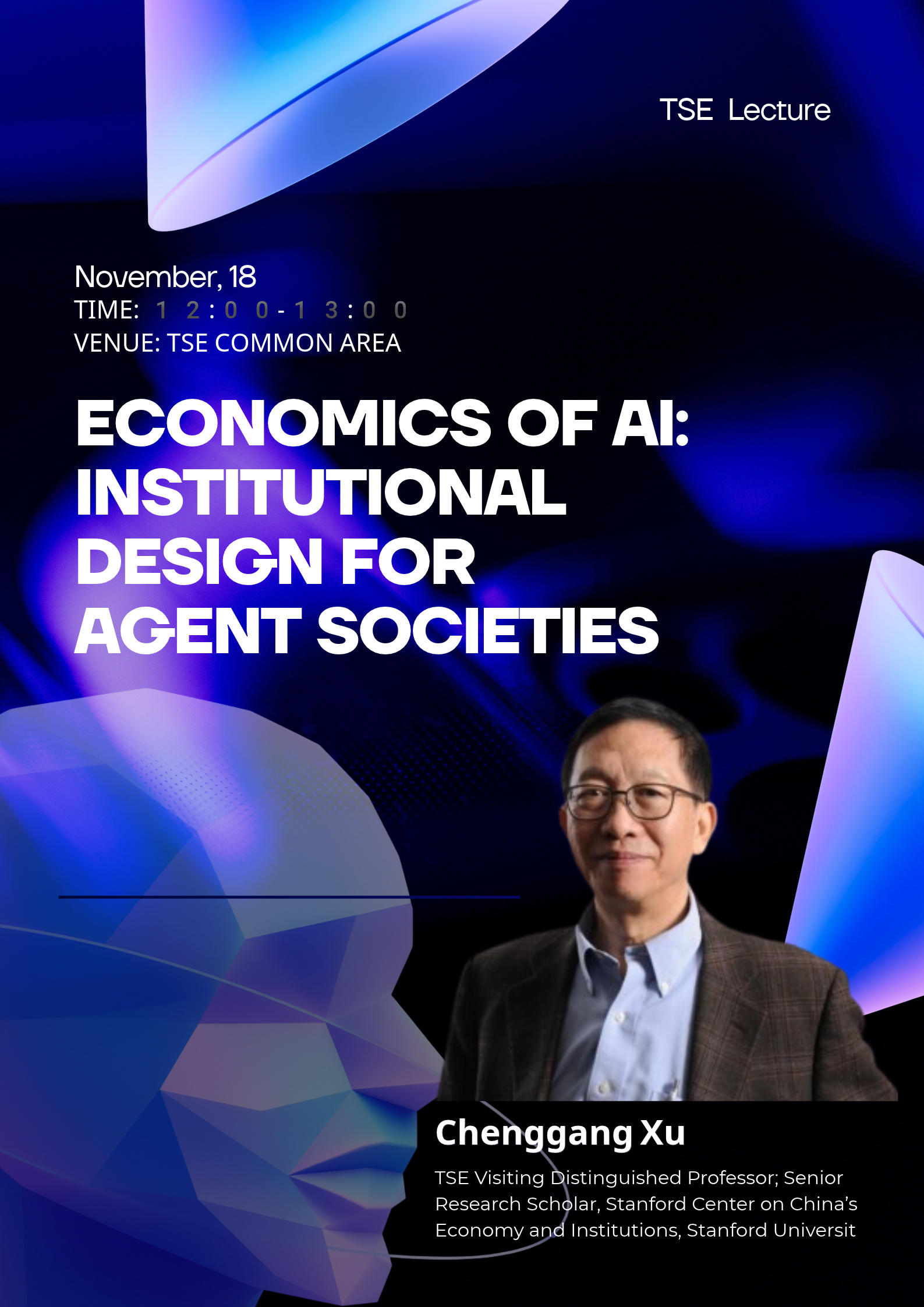
TSE Visiting Distinguished Professor; Senior Research Scholar, Stanford Center on China’s Economy and Institutions, Stanford University

Dean, Director of MA Program and TSE Distinguished Professor
Abstract: Superintelligence and AI safety are two sides of the same coin. A scientific understanding of both is essential to addressing the challenges they pose. I argue that
economic science is an indispensable part of this effort.
In this talk, I begin with the concept of bounded rationality developed by Herbert Simon, a Nobel laureate in economics and a leading pioneer of artificial intelligence, and then explore its relevance to AI agents and agent societies. AI agents are typically designed to maximize performance scores associated with their assigned tasks. When the objectives of individual agents are consistent with the objective of the overall agent system, their behavior is aligned with the intended design.
However, bounded rationality implies that no individual agent possesses the information, attention, memory, or computational capacity required to solve sufficiently
complex collective problems alone. As tasks become more complex, there is therefore a need to organize and coordinate large numbers of agents. At the same time, interactions among boundedly rational agents generate problems of coordination, communication, incentives, conflict, and governance.
As agent societies become larger, more autonomous, and more complex, these problems may exhibit systematic regularities analogous to those observed in human
societies. The behavior of individual agents within such complex systems may no longer remain consistent with global objectives, giving rise to misalignment. Traditional
engineering approaches to alignment may therefore be insufficient for addressing the institutional problems that emerge in agent societies.
About the Speaker:
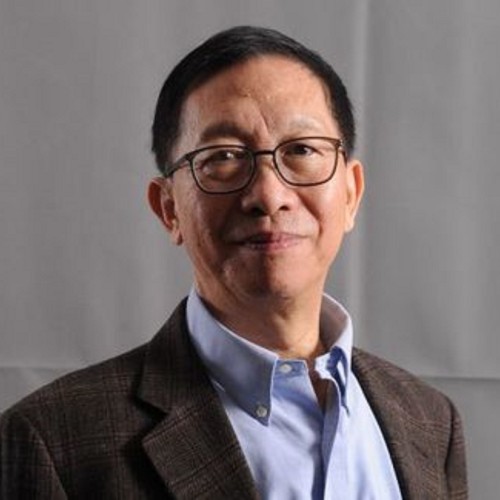
In addition to being a Visiting Distinguished Professor and teaching the Institutions and Economic Development course at TSE, Chenggang Xu is a Senior Research Scholar at the Stanford Center on China's Economic and Institutions, a Visiting Fellow at the Hoover Institution at Stanford University, and a Visiting Professor, Department of Finance, Imperial College London.
Chenggang received his PhD in Economics from Harvard University in 1991. He previously taught at the University of Hong Kong as Chung Hon-Dak Professor of Economics, at Tsinghua University as Special-term Professor of Economics, at Seoul National University as World-Class University Professor of Economics, and at LSE as Reader of Economics. He was the President of the Asian Law and Economics Association. He was a first recipient of China Economics Prize (2016) and a recipient of the Sun Yefang Economics Prize (2013).
Chenggang's research is in political economics, institutional economics, law and economics, development economics, transition economics and the Chinese political economy. His research and opinions have been covered widely in the Greater China area and in the world. He is currently a board member of the Ronald Coase Institute (RCI) and a research fellow of the CEPR.