
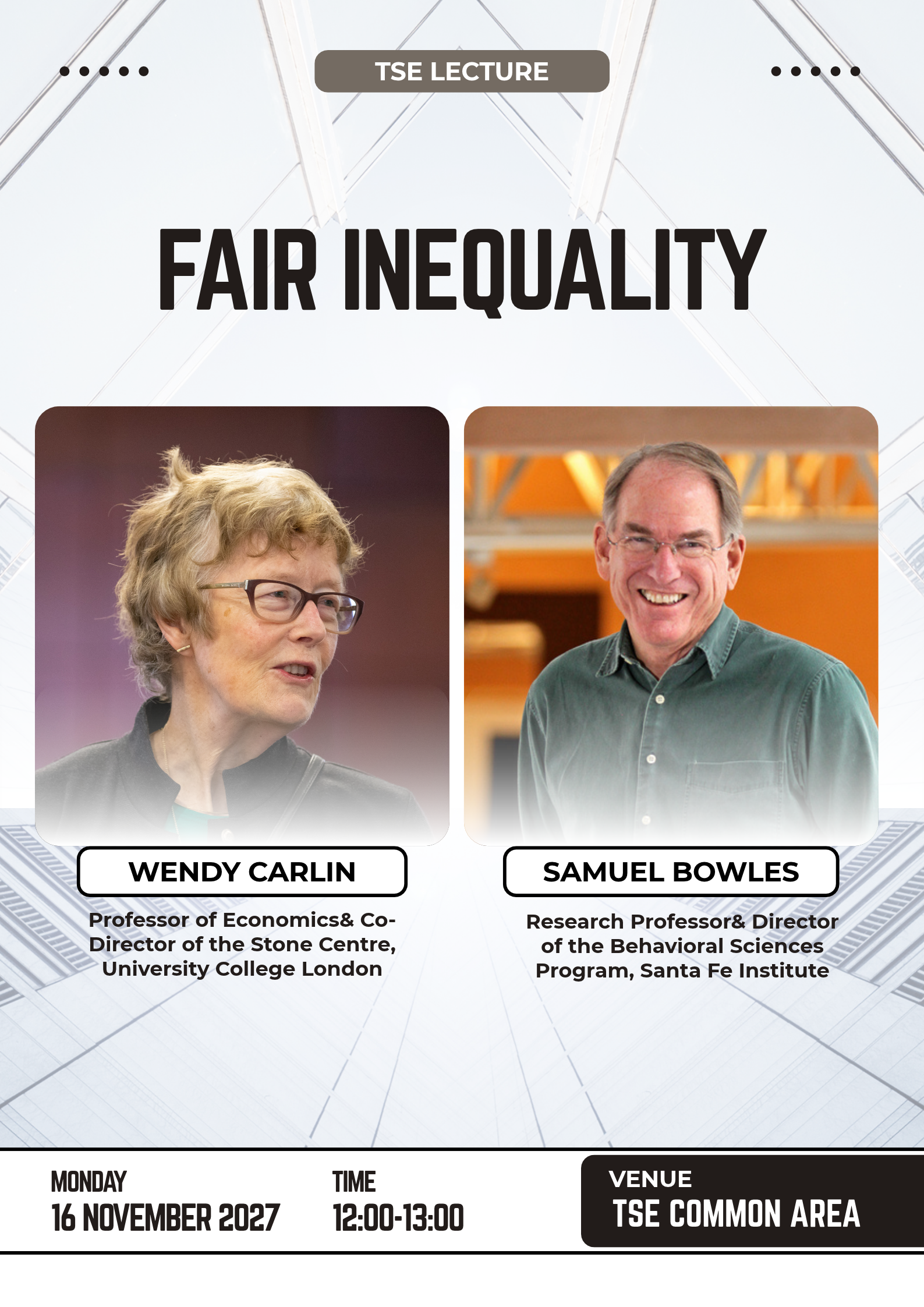
Schedule:
Please RSVP here by 13:30 Nov 12 (Thu).
Abstract:
If differences in market labor earnings were distributed identically to differences between same-sex siblings, how much inequality would remain? Our answer, reflecting Rawls’ Fair Equality of Opportunity Principle, is the “Fair Gini Coefficient”. We estimate this statistic for 16 countries from 5 continents using harmonized administrative data. We find that the remaining “fair" inequality averages around three quarters of observed inequality and differs little across countries, which implies that more equal countries are not distinctively fair. We characterize formal properties of our statistic and six related measures of gender and parental advantage, and provide estimates for the 16 countries.
For people coming to the Roundtable, attendees are invited to look at www.core-econ.org and at this JEL paper: https://www.aeaweb.org/
About the Speakers:
Wendy Carlin is Professor of Economics at University College London (UCL), Research Fellow of the Centre for Economic Policy Research (CEPR), and external professor at the Santa Fe Institute. She leads an international project - the CORE Econ project - to reform the undergraduate economics curriculum and is co-director of the James M. and Cathleen D. Stone Centre on Wealth Concentration, Inequality and the Economy. The CORE project produces open- access e-books used in universities around the world. Her research focuses on macroeconomics, institutions and economic performance, the economics of transition, and economic knowledge and education. She is a member of the Expert Advisory Panel of the UK's Office for Budget Responsibility. She has co-authored with David Soskice four macroeconomics books: Macroeconomics and the Wage Bargain (OUP, 1990), Macroeconomics: Imperfections, Institutions and Policies (OUP, 2006) and Macroeconomics: Institutions, Instability and the Financial System (OUP, 2015). The third book integrates the financial system into the macroeconomic model to allow for analysis of financial cycles as well as business cycles and growth. The fourth (2024) is titled Macroeconomics: Institutions, Instability, and Inequality. It brings to the fore how inequality can be incorporated in macroeconomic modelling of business cycles, financial instability, and growth in a unified way. In 2015, she was awarded a CBE for services to economics and public finance, in 2022 she was elected to the American Academy of Arts and Sciences, in 2023 as Fellow of the British Academy and of the Academy of Social Sciences, and in 2025 of the Royal Economic Society. In the New Year's Honours of 2026, Wendy was made a Dame Commander of the British Empire (DBE) for services to economics. She is President-Elect of the International Economic Association (the first woman and first Australian to hold this post).
Samuel Bowles (PhD, Economics, Harvard University) is Research Professor at the Santa Fe Institute. He taught economics at Harvard from 1965 to 1973 and since then at the University of Massachusetts, where he is now emeritus professor and at the University of Siena from 2002 to 2010 where he continues to occasionally teach. Bowles’ current research also includes theoretical and empirical studies of political hierarchy and wealth inequality and their evolution over the very long run. His studies on cultural and genetic evolution have challenged the conventional economic assumption that people are motivated entirely by self-interest. Recent papers have also explored how organizations, communities and nations could be better governed in light of the fact that altruistic and ethical motives are common in most populations. His scholarly papers have appeared in Science, Nature, New Scientist, American Economic Review, Theoretical Population Biology, Games and Economic Behavior, Journal of Theoretical Biology, Journal of Political Economy, Quarterly Journal of Economics, Behavioral and Brain Science, Philosophy and Public Affairs, Journal of Public Economics, Theoretical Primatology, Proceedings of the National Academy of Sciences (USA), Harvard Business Review, Journal of Economic Literature, Journal of Economic Perspectives, Current Anthropology, and the Economic Journal. His most recent book is The Moral Economy: Why good laws are no substitute for good citizens (Yale University Press, 2016). Other recent books include A Cooperative Species: Human reciprocity and its evolution (with Herbert Gintis, Princeton University Press, 2011), The new economics of inequality and redistribution, (Cambridge University Press, 2012), and Microeconomics: Behavior, Institutions and Evolution (Princeton University Press, 2004). He is currently working on Equality’s Moment: The origins and future of economic disparity and political hierarchy. He has also served as an economic advisor to the governments of Cuba, South Africa and Greece, to U.S presidential candidates Robert F. Kennedy and Jesse Jackson, to the Legislature of the State of New Mexico, to the Congress of South African Trade Unions, and to South African President Nelson Mandela. With CORE (Curriculum Open-access Resources for Economics), an international collaboration of economists, he has developed an open access new introduction to economics (see www.core-econ.org). With Simon Halliday, he has written a new text for intermediate microeconomics that will be published by Oxford University Press in 2020.