
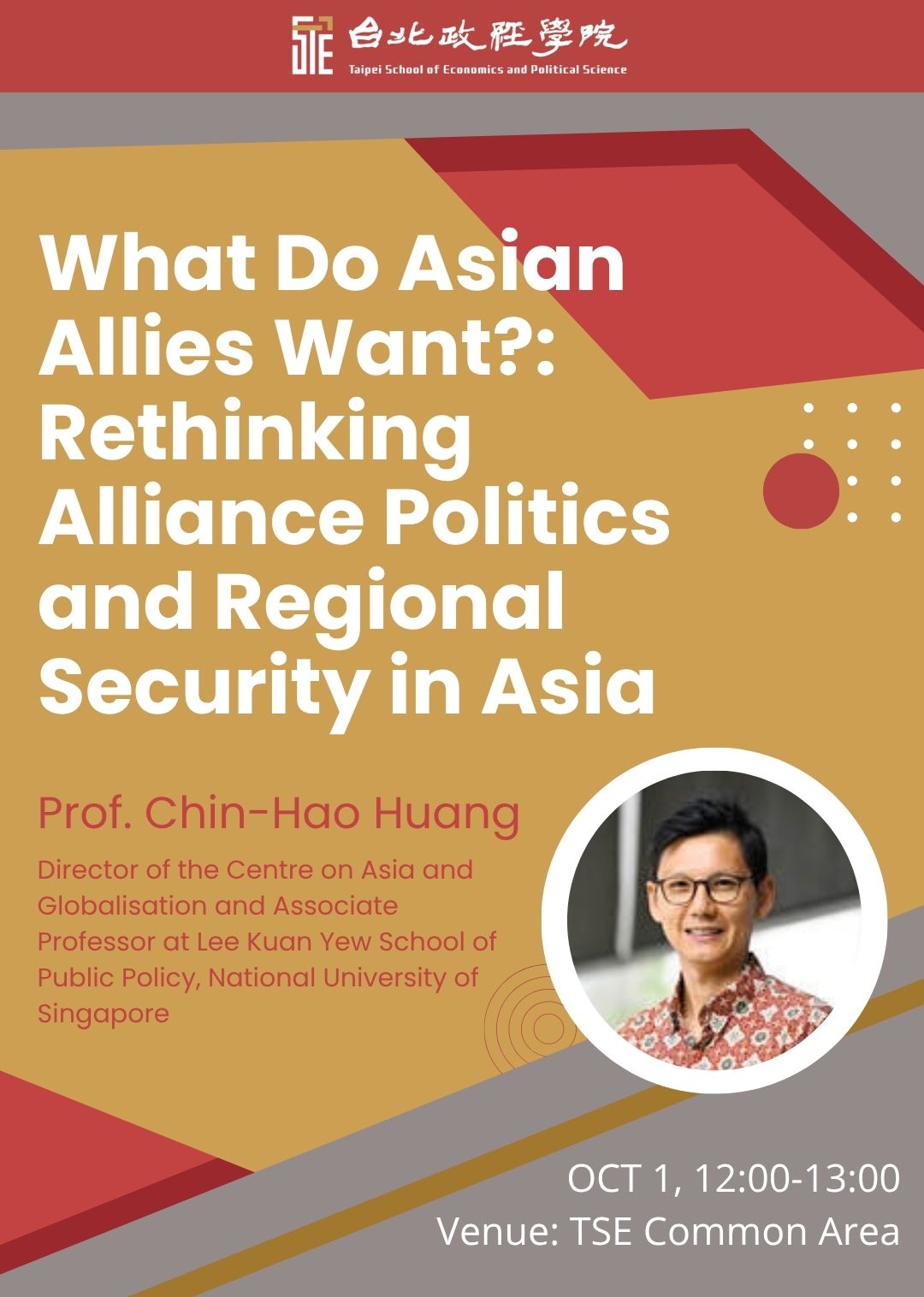
Lecture Abstract:
Rising unilateralism and receding global commitments are among the most notable shifts in U.S. foreign policy that are reshaping regional security dynamics and alliance politics in Asia. While the U.S.-led “hub-and-spokes” alliance system has historically underpinned regional stability, calls for greater burden-sharing are occurring amid intensifying U.S.-China competition and widening uncertainty about U.S. strategic priorities. A closer examination of how regional partners and allies are recalibrating their security ties with the United States and responding to U.S. offshore balancing priorities increasingly points to three inter-related implications: (1) the emergence of clearer fault lines between U.S. and Asian allies’ threat perceptions in the region; (2) a reversal in the balance of fears between abandonment and entrapment; and (3) a shift in assumed risks and moral hazard in alliance politics. These misalignments are creating new strains on alliance cohesion, particularly as Asian allies face growing expectations and pressure to adopt exclusive alignment and power balancing policies that they might otherwise prefer to avoid, thereby complicating efforts to sustain a stable regional order.
Speaker Bio:
Professor Chin-Hao Huang is an Associate Professor of Political Science and Director of the Centre on Asia and Globalisation at the Lee Kuan Yew School of Public Policy, National University of Singapore. Huang’s research and teaching focus on the intersection of international politics and regional security in Asia, with an empirical emphasis on China, Southeast Asia, and U.S.-China relations. His work examines the patterns of cooperation and conflict in historical and contemporary Asia, and how countries with disparate capacities in the region develop the requisite norms, consensus, and institutional mechanisms to achieve security. He is recognized as one of the top 30 global voices and intellectual innovators shaping the future of public debates on international affairs in Project Syndicate's inaugural Forward Thinkers list.