
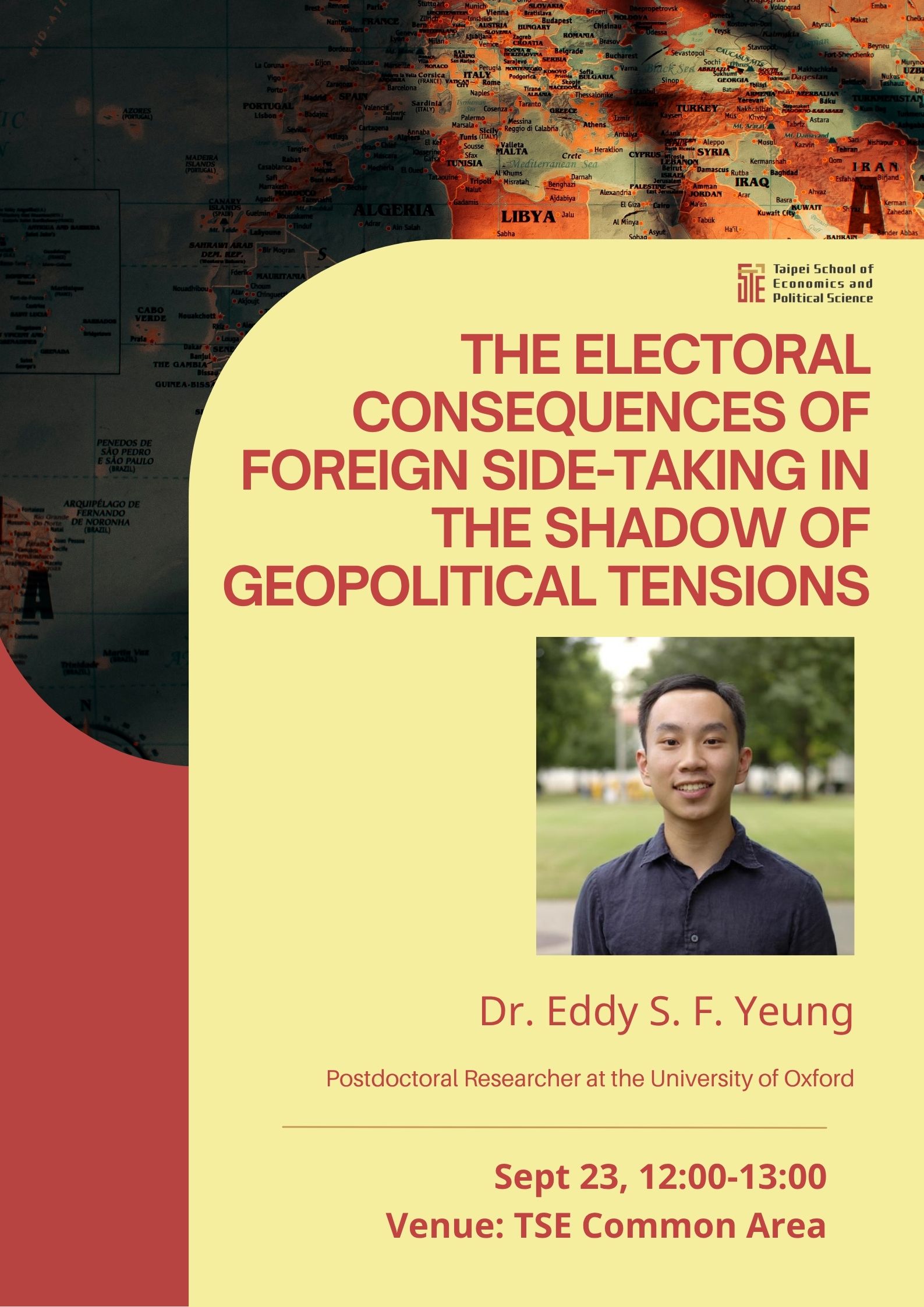
Speaker Bio:
Eddy S. F. Yeung is a Postdoctoral Researcher at the University of Oxford. He studies how political communication and elite strategy shape democratic legitimacy under autocracy and the psychology of conflict, with a focus on East Asia, the United States, and their interactions. Centering on mass–elite interactions, his recent research projects combine behavioral frameworks with modern social science techniques to unpack the microfoundations of democratic backsliding and conflict deescalation strategies.
His theoretical innovations on autocratic propaganda and democratic backsliding have received best paper and dissertation awards from APSA’s Democracy and Autocracy, Political Communication, and Political Psychology sections. His latest monograph (with Kai Quek), Deescalating a Trade War, was published by the Cambridge University Press (Elements in International Relations). His work has appeared in journals such as Science, British Journal of Political Science, Comparative Political Studies, International Organization, and The Journal of Politics.
Lecture Abstract:
Foreign electoral intervention is an increasingly popular tool for authoritarian powers to influence politics in the international system. One direct but understudied form of intervention is overt side-taking, a meddler’s explicit verbal endorsement of a domestic candidate. I unpack its impact on domestic electoral dynamics, theorizing a kiss-of-death logic: overt side-taking by a foreign rival will generate electoral backlash against the endorsed candidate. Consistent with this claim, a large-scale experiment administered to American voters shows that candidates endorsed by a US rival suffered significant electoral backlash, especially among respondents holding strong geopolitical concerns about the adversary. Ally endorsements, by contrast, aided endorsed candidates. A follow-up experiment finds that media warning about the disingenuous nature of rival endorsements didn’t temper their adverse electoral impact. These findings suggest that foreign adversaries can exploit the kiss-of-death logic and tip the balance of electoral support in favor of their preferred candidate through words alone.