
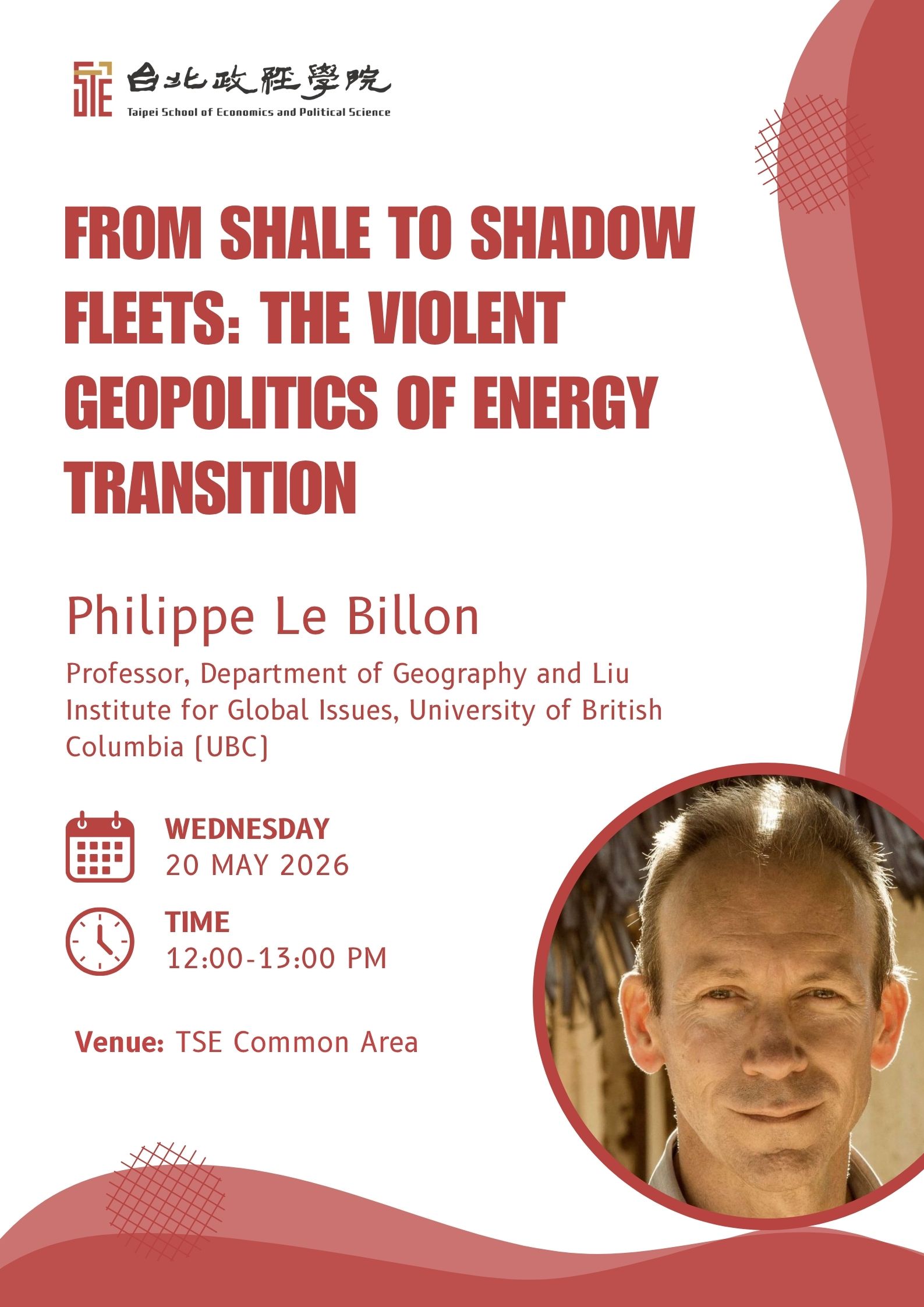
Title: "From Shale to Shadow Fleets: The Violent Geopolitics of Energy Transition"
Time: May 20 (Wed), 12:00-13:00
Venue: TSE Common Area
Speaker: Philippe Le Billon (Ph.D. Oxford, Fulbright Research Chair, Professor at the University of British Columbia with the Department of Geography and the Liu Institute for Global Issues)
Speaker Bio:
Philippe Le Billon (Ph.D. Oxford, Fulbright Research Chair) is a Professor of Political Geography at the University of British Columbia. His work focuses on the ways international relations and resource governance shape security dynamics, development trajectories, and sustainability outcomes. With extensive field and policy experience across conflict-affected and resource-rich regions, he held visiting positions at IAS in Princeton, UC Berkeley, and CERI/Science-Po Paris. Prior to academia, Professor Le Billon held positions with the French Ministry of Foreign Affairs, the United Nations Department of Peacekeeping Operations, as well as international and non-governmental organizations. He is author of The Great Green Grab. Climate Extractivism and the New Resource Imperialism (Hurst, 2026); Environmental Defenders: Deadly Struggles for Life and Territory (ed. Routledge,2021); Oil (Polity Press, 2017); Wars of Plunder: Conflicts, Profits and the Politics of Resources (Oxford UP, 2014); and more than 100 articles (see Google Scholar profile).
Lecture Abstract:
This talk examines how the energy transition is unfolding alongside a turbulent reconfiguration of oil and gas geopolitics. The shale boom in the United States transformed it into a leading exporter, reshaping global markets and weakening traditional dependencies. The subsequent Russian invasion of Ukraine and expanding sanctions regime have weaponized energy flows, driving fragmentation, “shadow fleets,” and persistent price volatility. Concurrently, interventions in Venezuela, along with tanker interdictions, LNG disruptions, and attacks in the Persian Gulf, underscore the growing militarization of energy circulation.
Asian countries and the European Union have responded by diversifying supplies, accelerating renewables, and advancing regulatory frameworks such as carbon pricing and critical minerals strategies, while Canada positions itself as both a stable hydrocarbon supplier and a key actor in critical minerals development. Yet these dynamics carry major climate implications: they risk reinforcing fossil fuel lock-in, incentivizing new production, and delaying decarbonization, even as climate pressures intensify. Addressing this requires not only accelerating renewable deployment, but actively dismantling structural dependencies on oil and gas through demand reduction, regulatory reform, and redistribution.
At the same time, a resource-intensive transition risks entrenching forms of “green extractivism,” while Asia’s dominance in critical minerals and low-carbon technologies repositions the region at the center of emerging industrial and geopolitical power. The transition thus hinges on whether Asian countries—alongside partners such as the EU and Canada, but also fossil fuel producers—can shape more equitable, low-carbon systems, or whether extractive dependencies and geopolitical rivalries will deepen.