
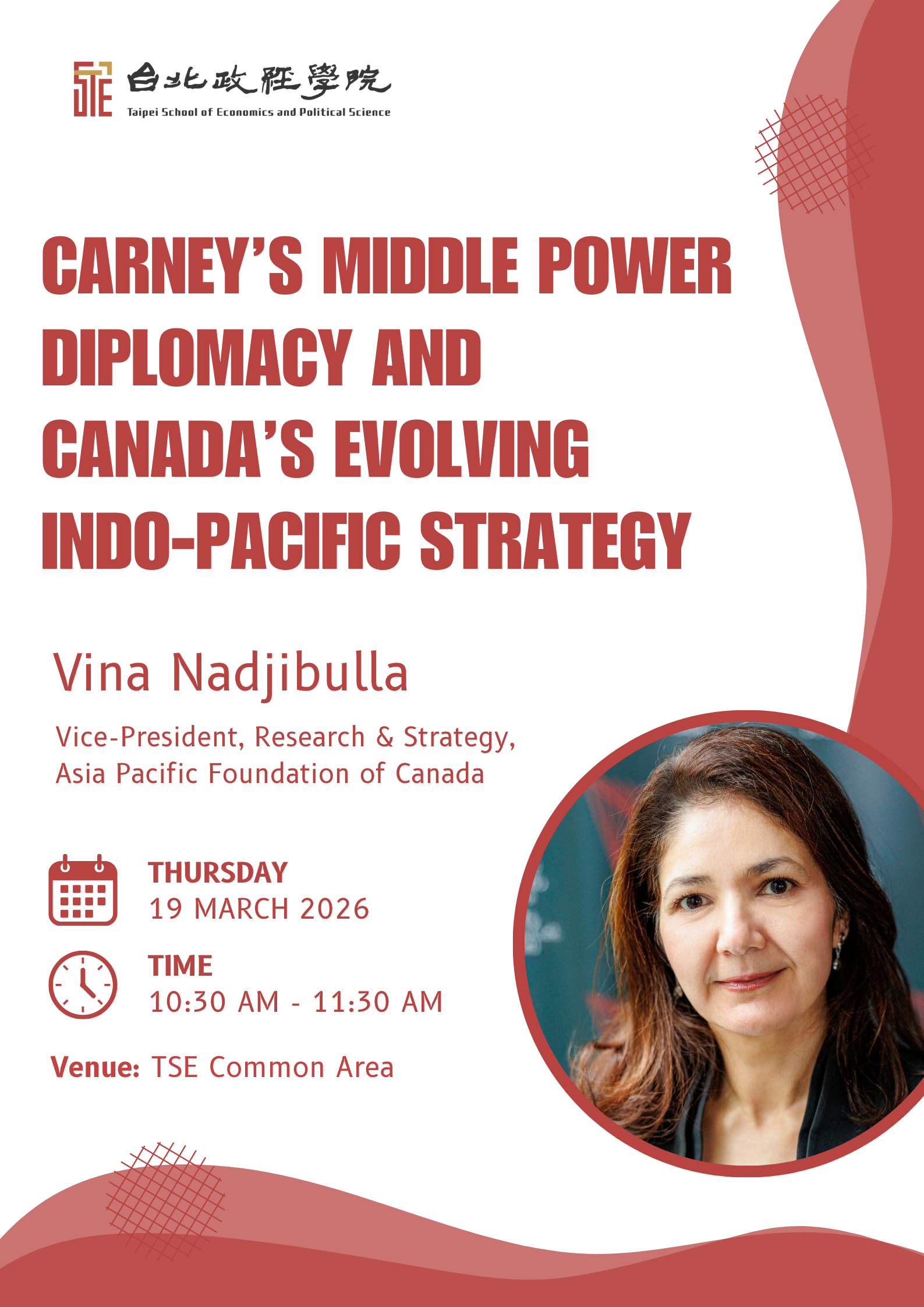
Title: Carney’s Middle Power Diplomacy and Canada’s Evolving Indo-Pacific Strategy
Time: March 19(Thur), 10:30-11:30 am
Venue: TSE Common Area
Speaker: Vina Nadjibulla (Vice-President, Research & Strategy, Asia Pacific Foundation of Canada)
Short Bio:
Vina Nadjibulla joined the Asia Pacific Foundation of Canada as Vice-President, Research & Strategy in November 2023.
In this role, she leads the Foundation’s research and programmatic activities focused on Canada’s engagement with the Indo-Pacific region. This includes overseeing APF Canada's research agenda, fellowship programs, education and capacity-building initiatives, and regional programming through the Indo-Pacific Initiative. She also plays a key role in strategic planning, stakeholder engagement, and advancing the Foundation’s public policy impact.
Vina is a frequent commentator on Canadian foreign policy and Indo-Pacific affairs, with a particular focus on Canada’s evolving relationships with China and India, and the region’s broader security, trade, and geopolitical dynamics.
As an international security and peace-building expert, Vina has more than two decades of experience in diplomacy, political analysis, and advocacy. She has worked with international organizations, governments, think tanks, and philanthropic institutions across Canada, the U.S., China, and Central Asia on issues ranging from conflict resolution and human rights to strategic risk and multilateral diplomacy.
She is also an Adjunct Professor at the School of Public Policy and Global Affairs at the University of British Columbia and a Senior Research Fellow at The Soufan Center in New York.
Vina holds a Master’s degree in International Affairs from Columbia University and is fluent in English, Russian, and Farsi, with intermediate proficiency in Mandarin. She is a Canadian citizen, born in the former Soviet Union, raised in Afghanistan, and educated in the United States.
Lecture Summary:
Vina Nadjibulla recounts that early this year, Canadian Prime Minister Mark Carney described a “global rupture”, explaining that the rules-based international order is not working anymore, specifically in trade driven by the US. Although economic interruptions are obvious, a security rupture is less manifested likely due to the current links between Canada and the US. Nevertheless, Canada is exploring ways to expand and scale down their US dependency. The argument is directed at whether this is a “rupture” or a “transformative phase”. These changes are shifting Canada’s foreign policy which is historically grounded in four pedestals: a solid relationship with the US, congruence with the NATO and G7, support for multilateralism and rules-based structures, and the manner in which certain countries, such as India and Sri Lanka, are perceived prior to China’s rise to power.
Building on this, Canada still continues to be a democracy with an effective social realm, establishing an arena for conversations and continued commitment to foreign policy at a significant period of history. Nadjibulla stresses the value of engaging in these discourses, especially with the help of working with the Indo-Pacific region. A primary issue posed is whether prevailing strains between the US and Canada are mainly prompted by individual leadership, specifically Donald Trump, and whether they will vanish after his retirement. Nadjibulla denounces this view, contending that while leaders matter, the destruction of trust between both countries is more profound and persistent. Trust requires decades to set up, but can be instantly wrecked, and it will not be smoothly repaired. Despite new leadership, skeletal shifts, like resolutions to sustain Canada’s national economy and weaken obstacles to trade, will remain influential in policy-making. These changes mirror key adjustments, which suggests that Canada is not likely to totally come back to its prior reliance on the US.
Questions also stem from the void between brash discussions and vigilant policy development, notably with respect to Canada’s strength in reaching increased independence from the US. Nadjibulla recommends paying less attention to plans told and more on real responses, which are: reinforcing economic robustness, strengthening domestic industries, and upholding resilience in diplomacy. Safeguarding agreements like the USMCA continue to be valuable, however Canada is foreseeing situations where it must respond more autonomously. Their attitude to this echoes how to take care of uncertainty in risky situations, stabilizing the threats of excessive reliance on the US with the premeditated possibility of modifying their allies. Nadjibulla wraps up the talk by underscoring that the US should first focus on its domestic disputes before fixing international ties. After all, a more equitable global position will rest on their domestic revival, and not just a smooth restoration of the hegemon they once were.
Composed by: Lorraine Yu (first-year PhD student)

Dean, Director of MA Program and TSE Distinguished Professor