
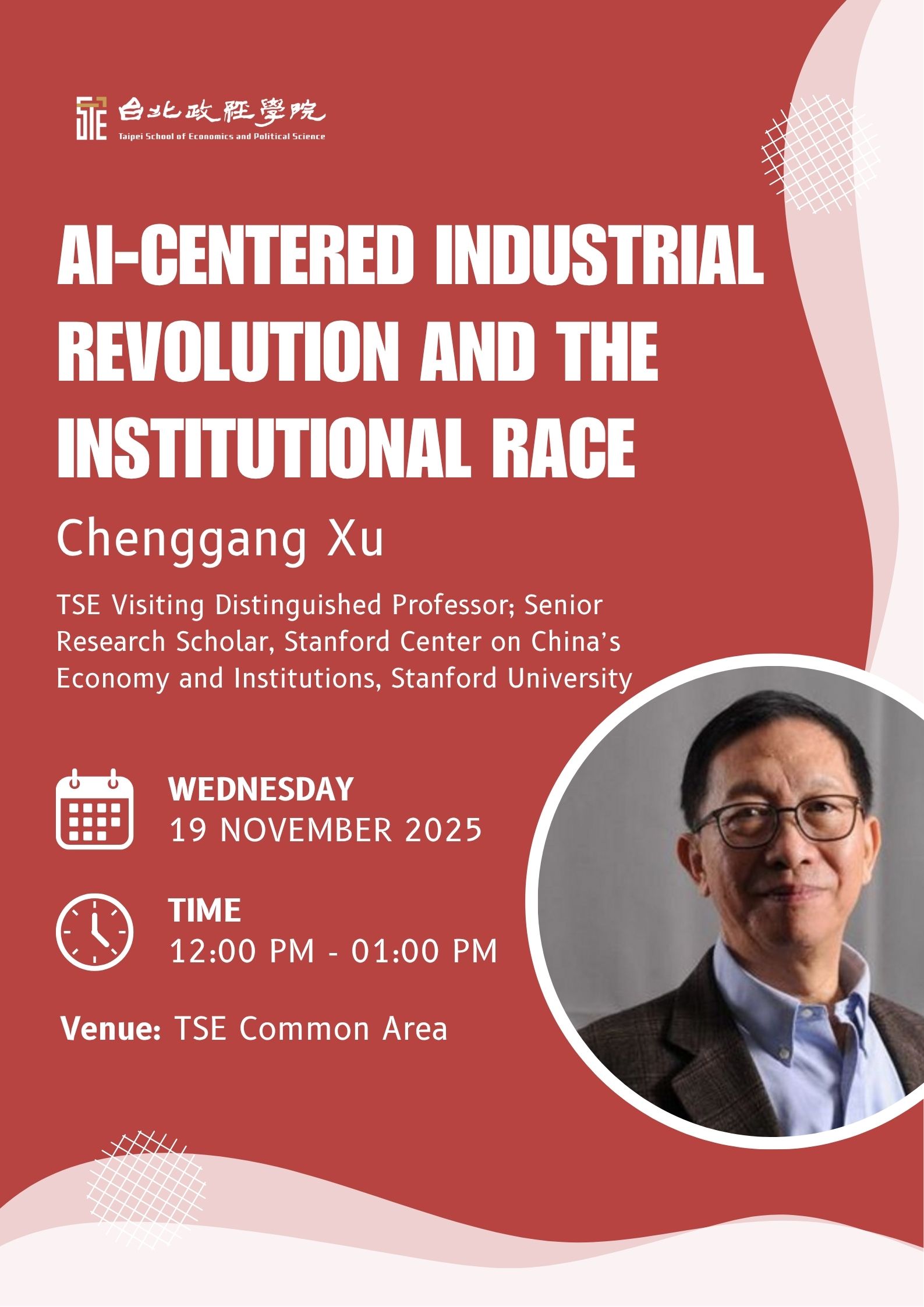
Title: AI-Centered Industrial Revolution and the Institutional Race
Time: November 19 (Wed), 12:00-13:00
Venue: TSE Common Area
Lecture Abstract:
An AI‑centered industrial revolution is emerging and rising rapidly. This revolution will be categorically different from its predecessors, as it promises to revolutionize human intelligence and transform every aspect of society. Industrial revolutions have only emerged under certain institutions and, in turn, have strengthened those institutions. Thus, they are never confined to races in science, technology, industry, or commerce; they are also races of institutions. Drawing on patterns from past industrial revolutions—particularly how institutions affected or interacted with these transformations—alongside the most recent data, this talk will discuss why and why these dynamics mattered historically and remain relevant today. The analysis offers insights into the much‑debated issue of the U.S.–China AI race.
Lecture Summary:
Professor Chenggang Xu, TSE Visiting Distinguished Professor and Senior Research Scholar at Stanford, presents “AI-Centered Industrial Revolution and the Institutional Race”, arguing that the emerging AI-centered industrial revolution (IR) is unprecedented in human history. Unlike previous revolutions driven primarily by mechanization, this IR revolves around intelligence, promising to transform science, technology, the economy, military power, and society at large. Xu emphasizes that the true competition is not merely US versus China, but an institutional race, where the political, legal, and economic systems determine which societies can generate and sustain disruptive innovation.
Historical IRs reveal consistent patterns: the First IR arose from Anglo-American institutions post-Glorious Revolution; the Second from American democratic capitalism, which fueled industrial growth and helped democracies defeat fascism; the Third through confrontation between democracies and communist economies. Across these revolutions, constitutionalism, rule-of-law, and market-based incentives enabled bottom-up discovery and “0-to-1” innovation. Totalitarian regimes, by contrast, are structurally disadvantaged at producing such breakthroughs, though they may excel in scaling technologies from “1-to-N.”
Applying these lessons to AI, Xu highlights that US democracy possess favorable institutional conditions: venture capital, open scientific exchange, market-driven incentives, and abundant labor-capital structures that reward AI adoption. China, despite strategic deployments and state-directed industrial policies, faces constraints in generating original breakthroughs and suffers from deflation and limited domestic demand, making revenue generation for AI companies uncertain.
Xu concludes that the AI-centered IR will be shaped first and foremost by institutional quality rather than geopolitics. Democracies remain best positioned to produce foundational innovations, while authoritarian regimes can compete primarily by scaling technologies. Understanding these institutional dynamics, Xu argues, reframes the US-China AI race and clarifies the conditions under which industrial revolutions succeed.
Composed by: Nicole Richi (TSE senior student)

TSE Visiting Distinguished Professor; Senior Research Scholar, Stanford Center on China’s Economy and Institutions, Stanford University