
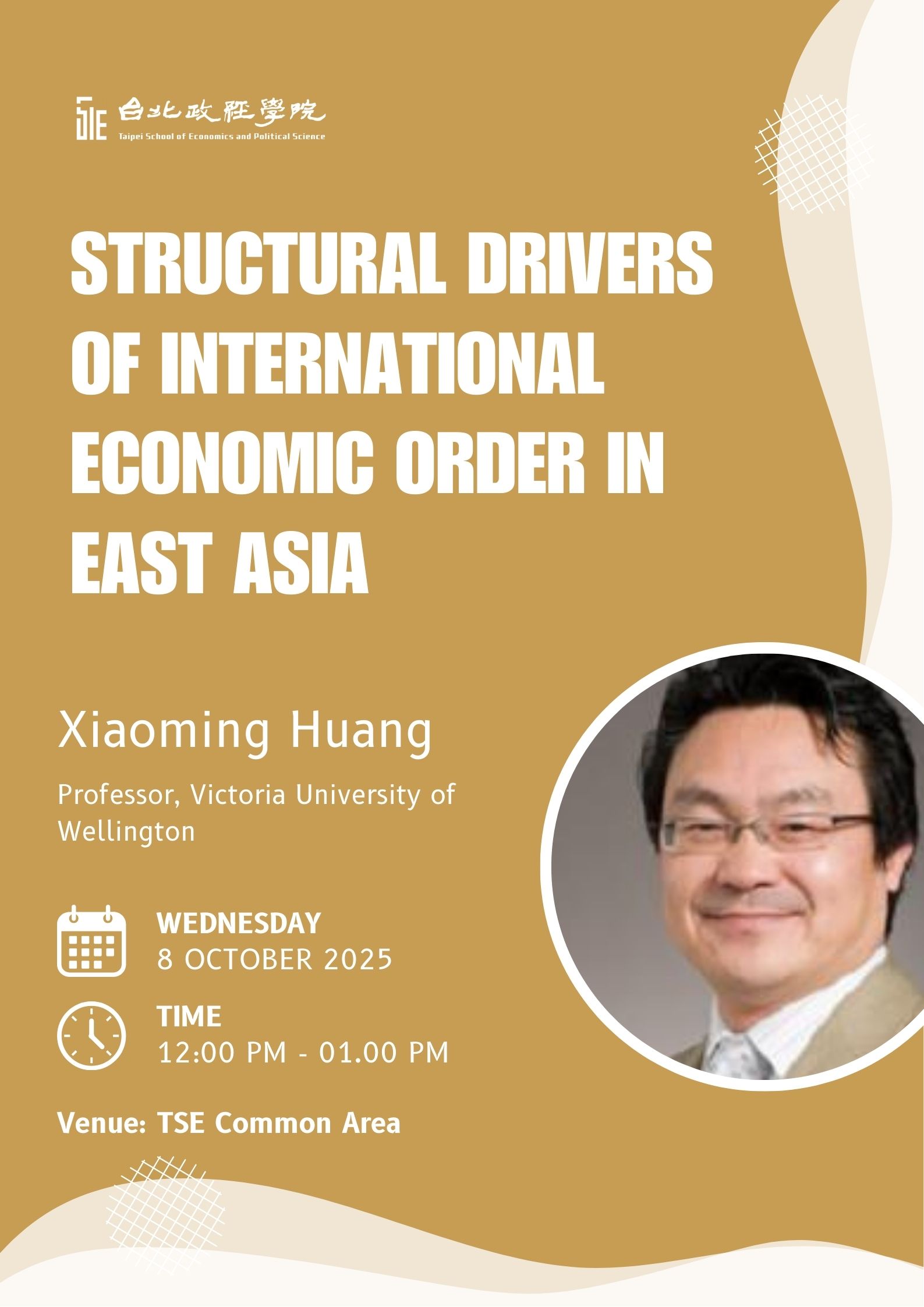
Title: Structural drivers of international economic order in East Asia
Time: October 8 (Wed), 12:00-13:30
Venue: TSE Common Area
Guest Speaker: Xiaoming Huang (International Relations Victoria University of Wellington)
Lecture Abstract:
Liberal institutionalism focuses on the role of international institutions in the shaping of international economic order. This seminar discusses the role of international structures. In the challenging times for the liberal international order in East Asia, international structures involve contending forces of trans-border industrial production and distribution, and the geopolitics of their organization. The rise and fall of these forces force countries to reorganize their international economic relations, "take sides" in alliances, networks and partnerships. Power shifts significantly limit the space in which countries can manoeuvre to maximize their interests.
Lecture Summary:
In “Structural Drivers of International Economic Order in East Asia,” Professor Xiaoming Huang examines how shifting industrial and geopolitical structures are transforming the foundations of the regional and global economic order. While liberal institutionalism traditionally emphasizes the role of international institutions in maintaining the liberal international order (LIO), Huang redirects attention to international structures—the underlying configurations of production, trade, and investment that shape how power and cooperation are organized.
He argues that the postwar unipolar hierarchy, long dominated by the United States, is giving way to a multipolar order driven by the economic ascent of East Asia. The liberal order, historically aligned with Western and Westphalian principles, is now in decline as structural forces—transborder industrial production, shifting supply chains, and geopolitical rivalries—reshape the global economy. Huang identifies three industrial systems: the European, American, and East Asian production networks. The US strategy of outsourcing manufacturing helped nurture East Asia’s rise, first under Japan’s leadership and now under China’s.
By tracing changes in manufacturing GDP, export flows, and FDI from 1970 to 2023, Huang demonstrates a major power shift toward East Asian economies. The collapse of a liberal hierarchy has altered the purpose of regional networks like APEC, as cooperation gives way to competition. Countries are increasingly compelled to “take sides” through minilateral partnerships, the Chip Alliance, and China’s Belt and Road Initiative, reflecting a nationalist and security-oriented turn.
Ultimately, Huang concludes that East Asia’s evolving order is no longer anchored in liberal institutional integration but in the structural realities of industrial interdependence and strategic rivalry. These shifts suggest a fragmented, security-driven, and multipolar economic landscape that limits smaller states’ room for maneuver while redefining the basis of international cooperation.