
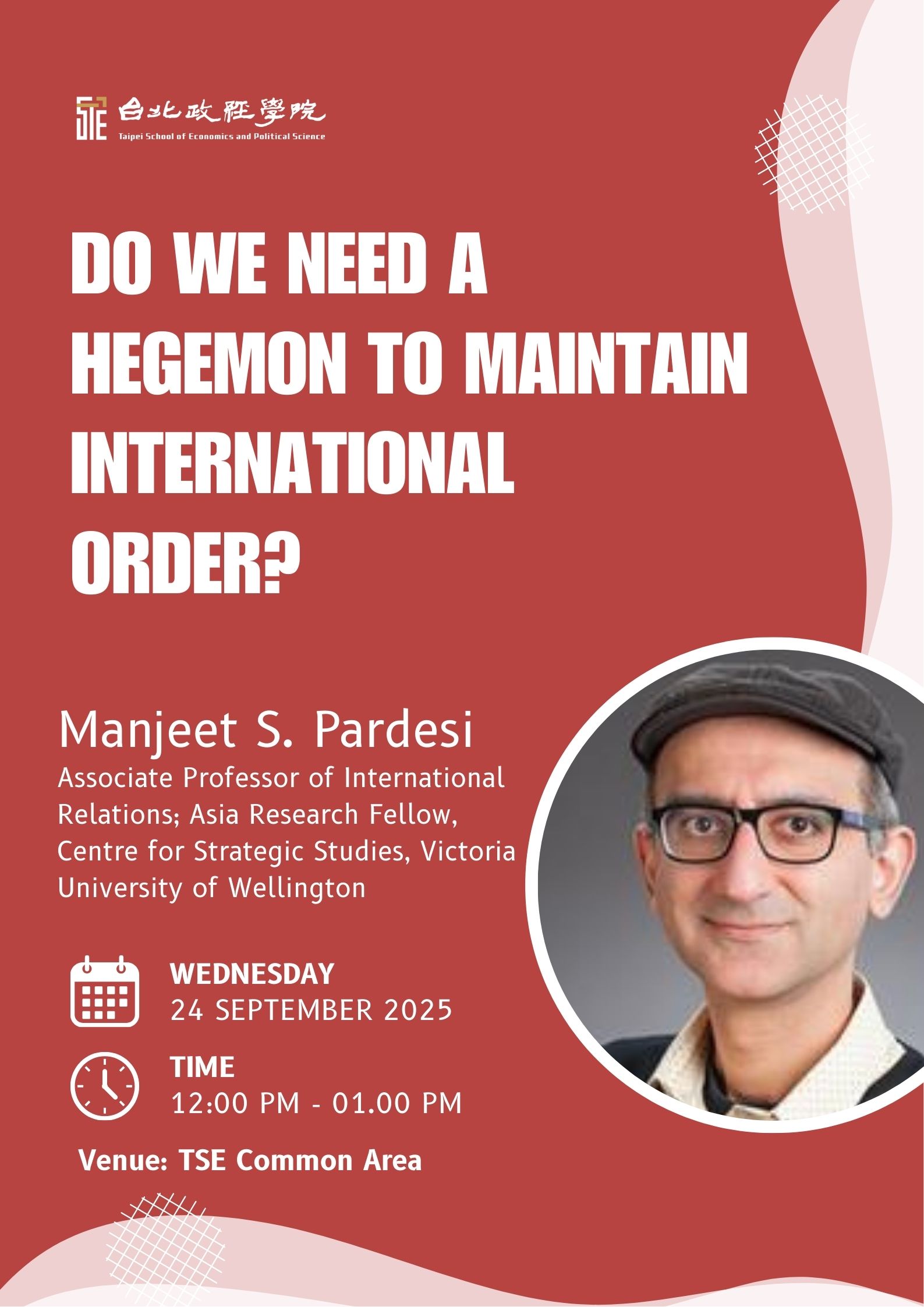
Title: Do we need a hegemon to maintain international order?
Time: September 24 (Wed), 12:00-13:30
Venue: TSE Common Area
Guest Speaker: Manjeet S. Pardesi (Associate Professor of International Relations; Asia Research Fellow, Centre for Strategic Studies, Victoria University of Wellington)
Lecture Abstract:
With the return of Donald Trump to the White House, the fate of the U.S.-led Liberal International Order (LIO), already in doubt, has darkened considerably more. But what comes after it? In contrast to traditional accounts that foresee disorder, or an epic Thucydidean contest between the U.S. and China, or even Chinese hegemony, we argue that the classical eastern Indian Ocean (~1 st —15 th centuries CE) corresponding with modern Southeast Asia—before the arrival of European imperial powers—provides a powerful model for the emerging international order after American hegemony. Then, an expansive, vibrant, and rules-based order of trade and cultural flows was organized not by the great powers, whether China or India or others, but by the small and dynamic polities of Southeast Asia. The classical Indian Ocean challenges the hegemonic and great power ordering paradigm and shows that dense commercial and cultural interactions can hold international systems together. (Based on the author’s book with Amitav Acharya mentioned below).
Short Bio:
Manjeet S. Pardesi is Associate Professor of International Relations in the Political Science and International Relations Programme, and Asia Research Fellow at the Centre for Strategic Studies at Victoria University of Wellington. His research interests include World Orders and World/Global History, Great Power Politics, Asian security, and the Sino-Indian rivalry. His most recent book, Divergent Worlds: What the Ancient Mediterranean and Indian Ocean Can Tell Us About the Future of International Order (co-authored with Amitav Acharya) was published by Yale University Press in 2025.
Lecture Summary:
In his lecture, Professor Manjeet S. Pardesi questions a common idea in international relations: that a stable global order needs a single powerful country (like ancient Rome or the modern United States) to lead and enforce rules. He argues this view is based mostly on European history and ignores other historical examples.
He focuses on the Eastern Indian Ocean region before the 15th century, especially Southeast Asia, which had no single dominant power. Instead, hundreds of independent kingdoms, called “mandalas”, coexisted. They traded, exchanged ideas, and formed diplomatic ties without being controlled by one empire. China’s so-called “tribute system” was not about domination; it worked more like gift-giving, where envoys from Southeast Asia brought gifts to China and often received even more valuable items in return. This encouraged trade and peaceful interaction.
Indian and Chinese cultural ideas like Hinduism, Buddhism, and political models, spread through this region, but local rulers adapted them to fit their own societies rather than copying them directly. There was no central navy or military force keeping order. Instead, cooperation came from many actors working together.
Pardesi adds that maritime commerce was central to this system, with Indian, Arab, and later Chinese traders participating freely across the Bay of Bengal and South China Sea. He notes that even during the Song dynasty, when China developed a strong navy and derived up to 70% of state revenue from maritime trade, it did not seek to dominate Southeast Asia militarily. The Mongol invasions later failed in the region, reinforcing that military conquest was not the basis of order. Crucially, Southeast Asian states engaged China not out of subordination but to gain access to trade opportunities. This decentralized, multiplex system driven by shared norms, mutual recognition, and economic interdependence, functioned effectively for centuries without a hegemon. Pardesi suggests this historical model offers useful lessons for today’s Asia, where countries are avoiding strict alliances with major powers like the U.S. or China and instead managing regional issues together, much like the old mandala system.
Composed by: Sirius Osiris Torijano Alfonso (TSE PhD student)