
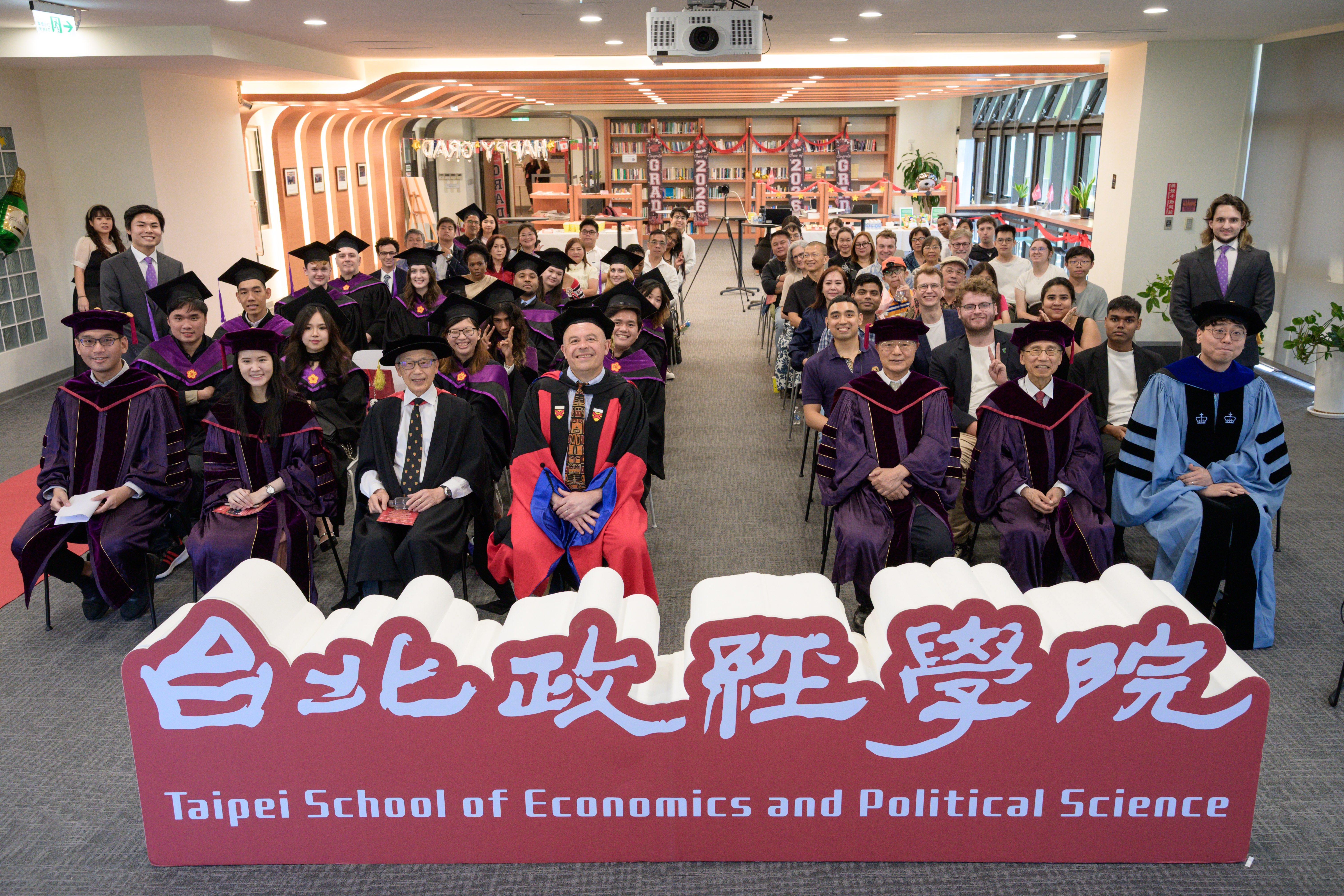
Congratulations, Class of 2026!!
On May 30th, 2026, we celebrated an unforgettable commencement and the Class of 2026's remarkable accomplishments.
Thank you to our graduates, families, friends, faculty, staff, and supporters who helped make this year's commencement a meaningful and memorable occasion. Whether you crossed the stage, supported a graduate in person, or joined us from afar, thank you for being part of this celebration.
If you missed the ceremony—or would like to revisit it—you can watch the livestream recording, revisit inspiring commencement speeches, view photos, and explore highlights from the day below.
As our graduates begin their next chapter, we wish them continued success, purpose, and joy in all that lies ahead. Once a member of the TSE community, always a member of the TSE community.
Congratulations once again to the Class of 2026. We are excited to see where your journey takes you next.
TSE Class of 2026 Commencement (livestream)
Happy Graduation Class of 2026! (prepared by TSE 2026 Graduation Planning Committee) - team comprised of TSE juniors and PhD students
Professor Speeches
Before joining TSE, he has been a Professor of Political Science, Director Emeritus of the Institute of Asian Research, and Konwakai Chair in Japanese Research at the University of British Columbia. He also founded the Master of Public Policy and Global Affairs (MPPGA) and served as its first co-director.
Yves is a Distinguished Fellow at the Asia-Pacific Foundation of Canada and the University of Alberta’s China Institute, and a visiting professor at the University of Tokyo’s Graduate School of Public Policy (GrASPP). In the past, he has held other visiting professor positions at Sciences Po Paris, GRIPS (Tokyo), National Chengchi University (Taiwan) and the Jakarta School of Public Policy (Indonesia). His research focuses on global order, East Asian political economy, and global economic and environmental governance.
A native of Bretagne, France, Yves enjoys growing heirloom apples and roses with his wife, Yvonne. Together, they are passionate about whale photography, local teas, century-old trees, and the wisdom of civilizations across Asia and beyond.
Dear TSE graduates and dear parents and friends:
How are you doing? Today is the day!
As the Dean of TSE, it is my great honour to start this ceremony by offering you GIANT
CONGRATULATIONS ON YOUR TSE GRADUATION!!!!
You have succeeded in taking all those exams, writing all those papers—sometimes just at midnight, or just about—and that beautiful thesis, which is either done or nearly done!
And you have learnt from amazing faculty and been supported by our amazing staff. You have shared two years with amazing fellow students, who may now be friends for life.
You have also braved the hard beds in dorms, the mighty Hsinchu wind, and the occasional typhoon. You have lived next to TSMC, the pulsating engine of the AI revolution!
Today, you are receiving one of the most special degrees in the entire world. No other global institution embeds such a level of ambition, excellence, and vision as well as values of hope and happiness.
There is a great history behind your degree and great ideas. At the heart of your TSE degree, lies a great ambition to address the changing global political economy and global order with new creative energy and the best tools from a large array of disciplines.
In a time of great technological acceleration, international disruption, and environmental change, everything we do here at TSE matters! And you are now part of this great endeavour!
TSE is your forever home! And we will always welcome you back with a big smile!
PLACE
You are graduating in a very special place: NTHU in Hsinchu, at the heart of the Taiwan Silicon Valley and of the AI revolution powering the world. JENSEN HUANG of Nvidia on May 26 in Taiwan just said that Taiwan is the heart of the AI transformation.
Taiwan is the true heart of East Asia, North and South.
Taiwan is an amazing island with some of the most stunning geography, biodiversity, and indigenous history in the world.
Taiwan is an amazing society and democracy, resilient and incredibly hospitable.
It is a place of freedom, delicious food, and the best pineapple in the world.
THANKS and GRATITUDE
We give thanks today!! First, thanks to your parents and family and close ones. All those who came and who couldn’t come today. Thank you for being here with us. We are very, very happy.
INSPIRATION
Commencement Ceremonies are a chance to rise above the daily constraints and grasp some larger truths. It is a day to be inspired! There is this ancient tradition inherited from centuries of higher education to share some of life’s secrets from elders to those who start the exciting journey of professional and adult life.
A story….. from YT:
When I was 19 years old, I went backpacking around North America. Hitch-hiking mostly, sleeping in fields, eating blackberries, but I found myself on a ferry on the ocean. And as I saw a seal and a bunch of eagles, I had this inspiration and I picked up my diary. I wrote a whole vision for my life. And the vision was after finishing an MBA, working, etc, to study about peace, global order, justice, and go do a PhD. I even wrote Stanford, then I wanted to be at Harvard. And I wanted to be a connector between east and west, and think about global issues for the global public goods.
And then a year later, I went to a small island and I wrote a hundred-page plan with seventy chapters. And literally, half of that book is accomplished; the other is yet to do. But a lot of the things I wrote on that ferry at 19 years old is what happened afterwards. So the vision here is that you can literally—if you spend time, step back, get to know your deeper self, what really motivates you, what’s your genius—you can literally make things happen. And you can have a huge impact on your life and around you. I want you to believe in this, because literally when I wrote all this, I didn’t think it was possible. But it gives you a script, and then you could follow it.
So be careful what you dream, what you wish for. You will probably accomplish it!
But it’s your time now, as you graduate, to think big.
So, I have three secrets for you. Three key words.
FIRST, Awareness: Be aware of your potential and gifts - with this TSE degree and education, you are incredibly empowered beyond actually what you can realize now. A lot of the seeds that you’ve received from your TSE education, all the conversations, all the things you read, you learned, you heard, and other things that you experienced here will grow with you over many decades. And you will realize, gradually. So it’s actually a treasure that’s going to keep expanding and giving to your life. You are now tasked with managing this treasure. Believe in yourself. Set high goals and follow your dreams. Never sell yourself short. You have a special role to play in your community and in this world. Remember also to nurture your knowledge. We are in an age where knowledge is not like before where you did it and now you can just expand it. You’re going to have to keep learning, because we’re in such a fast changing world. So always remain curious! Listen to your inner genius. The most important things that you look for in your life are actually hidden inside you. But often we don’t hear it, because it requires stepping back, pausing, and discovering what’s your true talents - your true genius. Make time for it. Listen to your deep intuition. Knowledge is the beginning–is the tools–but you need your intuition to guide you. Intuition will guide while your reason and your tools will give you the power to accomplish what your intuition wishes to do. And you have to work on resilience. Build good habits of resilience. Go exercise tomorrow morning and sleep well.
So that’s about awareness and being aware of those talents, and taking good care of them, like treasure in a garden.
SECOND, Responsibility - listen to your calling. As you strive for excellence, let there be room for your sense of responsibility toward your community, your family, your country, and the world.
THIRD, care and compassion - pause when needed to support your family and fellow community members. As you compete for the best and strive for excellence, keep space in your heart for others. Be still and listen, when the time comes. You can be great in your work and also be a beacon of stability and hope for others. Keep the time and habit to be grateful for the great gifts that you’ve received from others and from the Earth. We can excel and care for others at the same time. It is not an either-or. The future of humanity depends on us keeping our humanity.
And here comes the bonus: humor. Always have fun. Follow your playfulness. Never cease to be a child. The best work and human achievements that have changed the world are maybe always the result of playfulness and flow.
As you take on the journey of life..
Be your true self
Be inspired
Be kind… and smile..
Once again, TSE graduates, ONE BILLION CONGRATULATIONS for your hard work and achievements!!!
I’m really, really happy and delighted to join this ceremony. This is the fourth one, I think, since the school was established in 2021.
So I’m really lucky, so lucky, to be able to see through the whole process and see the family of TSE growing, with more people coming from different parts of the world and more professors joining, including our dean and the young junior faculty. It is really a great sort of satisfaction for myself.
So I'd like to again offer my sincere congratulations to our graduates and also thanks for the parents who are here today.
Thank you for supporting your children to come here to Taiwan. It's not an easy decision as I understand because Taiwan was considered by some as the most dangerous place on earth.
And we are repeatedly trying to prove that Taiwan is actually a safe place. I always tell my friends when they ask these questions that we have lived through this kind of imagination for the last 70 years since I was born on this island. [We have lived through] this message you were getting that never stops even until today.
So I think after these two years in Hsinchu, as Dean Yves has alluded to, I hope you have realized that Taiwan is not only safe in terms of national security, but it’s actually also very very safe for personal security, right? You should be able to go around the town any time of the day and night, I hope. I've not heard of any trouble that you have encountered, and I believe that the people you interact with are the most hospitable people in the world.
That’s the reason, I think, that we build this institution here: hoping to use a very special asset of this island in addition to our high-tech industry to attract the most talented students and professors to come to this institution and to put up a really good excellent outstanding education institution—not only for Taiwan, but for Asia and the entire world overall.
So we tend to keep that tradition, and I think we've been successful, proven by your attendance and what you have done up to this point and upon graduation.
We have a saying called “鵬程萬里 (Péng chéng wànlǐ),” meaning “I wish you a good journey that will fly very high to reach a very esteemed target 10,000 miles away.“
This is supposed to be the beginning of the journey, right? We call today a “commencement,” which really means “the beginning,” right? And not “the end of the education.”
So it doesn't mean that your education is going to end here.
It's actually the starting point of your professional career.
So I really want to wish everybody the best luck and so please follow what Dean Tiberghien has said: be ambitious. Aim high, have dreams, go for it, don't worry, and have fun in the process.
I know that some people are looking for a job. If you're looking for a job here, I wish you the best luck. If you're looking for a job outside of Taiwan, I also wish that you get the job you wish for.
If you're not quite sure what you want to do, I also advise you to look for some kind of job. It’ll be very good to experiment. I’m of the belief that young people should have some working experience before they go for PhD studies. I think this working experience—whether you turn out to like it or not—is always very beneficial to your eventual endeavor(s).
As some of you may know, some of our alumni are here. I'm very happy to see them come back. I already advised Kurt, Sam, and Abhi to organize a TSE alumni association for future graduates and come back.
Again, thank you, and I wish you the best of luck.
Thank you.
有缘 is karmic affinity or happy encounter! It’s a karmic connection, a cherished affinity that we were here together at TSE for two golden years. Please keep in mind that class experience and friendship are for lifetime.
氣勢 qi-shih means momentum. This is the lunar year of the horse. You have generated momentum from writing a good number of papers to completing a thesis. Some papers are already accepted for publication in academic outlets. Be sure to continue to harness your momentum. The sky is the limit.
After so many good stories, I just can’t refuse to tell you mine. A long, long time ago, there was someone called “Pangu (盤古)”. He was the person, as we are told, to create heaven and earth. And my query is—and perhaps for many of you too—what was there before the creation of heaven and earth?
It’s something called “Hundun 混沌”, so the story goes. And it seems to me that it’s a huge mass of confusion—of different things put together. For lack of a proper translation, perhaps we may call that “muddled confusion”. It's something that is muddling, that is pretty confused, and that was then, at the beginning of the world we have inherited.
Let us fast forward trillions of years to the current situation. And what we are witnessing now is a world which is still very much in great confusion and great muddling.
We can read a lot of things such as wars and conflicts here and there. We can see tariffs around the world as well as choke points here and there. Lots of natural disasters as a result of us: human-induced environmental change.
My question is—to myself and to you—what should we do? What can we do in this kind of situation? Apart from embracing the kind of change that we are now experiencing in this world, we try to live with it. But apart from that, what can we do?
Well, we can either choose to do something useful—according to our reckoning—or we can choose to do nothing—in other words, wuwei (無為)—according to the Chinese Daoist advice.
So, between doing something useful and doing nothing at all—especially something rash—there are lots of opportunities in between, isn't it?
I hope we can find our own path, a kind of middle way in which we can excel ourselves as suggested by our two deans. That perhaps is the way in which we can explore the world to find our golden mean—our happy medium.
And on this particular day of happiness, may I wish you all the best in your endeavor to find your middle path.
Thank you!
So good afternoon graduates, families, colleagues, and friends. Congratulations to the graduating class of 2026.
As a faculty member, one of the most rewarding parts of teaching is to see students gradually develop their own way of understanding the world. Not simply learning about theories, remembering concepts, but learning how to ask difficult questions, how to think critically, and how to remain intellectually honest, even when the answers are not comfortable.
At TSE, we usually emphasize that economics and politics are not just about models, elections, markets, or statistics. They are actually automatically about people, how societies organize power, how society resolve conflicts and imagine um imagine families.
So behind every data set is human experience.
Behind every policy debate are real troubles which can affect people's lives.
So some of you will go into academia, government, business, journalism, civil society, or completely different paths. Whatever you do, I hope you will carry with you not only ambition, but also curiosity, humility, and empathy. The ability to succeed matters, but the ability to think carefully, to remain open-minded, and to treat others with dignity and recognition may matter even more.
As you leave the campus, remember that education is not merely about personal achievements. It is also a responsibility. So use what you learn not only to advance yourselves, but also to contribute to your communities and to the broader society we all share.
Finally, on behalf of faculty, thank you for choosing TSE to be part of your journey. We are very proud of you about your achievements and even more excited about what you will become in the future.
Congratulations again, Class of 2026. We wish you wisdom, purpose, and courage in the years ahead.
Thank you.
First of all, for those of you who all made very, very long trips to get here, massive congratulations. As I understand, I know some of you come from the United States—and some of you have made trips from Eswatini—to come here to see the graduation ceremony, which is actually a massive thing to congratulate in itself.
Now a couple of things that I wish that some of you graduating today take for your life.
First of all, your degree from the Taipei School of Economics and Political Science is really, really special, because when somebody asks for an expertise in political science and somebody asks for somebody with expertise in economics, you can answer to both of these calls. I can assure you not many degrees out there—even in the United States—can help you do that.
And what we hope that we taught you is that although political science and economics tends to look at the same problem from a different angle—for instance, Yumin’s training is in political science, and my training is in economics. Obviously, we may look at the same issues differently—but ultimately what we hope that you guys take away is that these points of views are actually complimentary. That you cannot have a full picture of an issue without one of these two.
And more importantly, intellectually, what we hope that you guys can take is an ambitious curiosity because, to be honest, we didn't really teach you everything.
In fact, no degree does. Not even a PhD in economics at places like Harvard or MIT or Colombia teaches you everything. (And if you want to learn everything, you need to be enrolled in school for 100 years and you'll probably learn maybe like 10% of the entire knowledge out there.)
However, one thing that I hope that you got to learn is that before you came to TSE, maybe there were some questions that you were completely unaware about but then through the education you got to understand, you got to see the world differently, and then started asking questions like “Hey, why do some countries go into conflict when obviously conflict does have massive harms?” or “Why are public institutions or bureaucracies in some countries organized this way?” whereas the typical answer would say that it's not necessarily the best.
So we didn't teach you everything, but we hope that what we taught you is what the one question in your life that you got to understand as a result of this education is and what the one question that you're dying to answer is—either through further studies in academia or your actual industry work—that helps you drive yourself forward in your life.
Now, besides academics, there's one perhaps arguably more important thing than the academic side of this that we as a TSE faculty want you guys to take, for graduates specifically. I'm going to ask you to do a couple of things:
Please look to your left.
And then to your right.
The reason I did that is that the people on the left and right—and for completeness, I probably should have said “look at the front and the back” too—are the biggest asset I hope that you take from the TSE degree.
You’ve met friends for life because—especially for a lot of you—you guys didn't have to just overcome the academic barrier; some of you also had to overcome language barriers as well.
But given that you guys are already here, you guys pretty much overcame two barriers in a very spectacular fashion. So congratulations on that.
Lastly, after today, whoever is here for you today, your friends or family, do enjoy today. (Although I must also tell you that the weather is now starting to become pretty brutal in terms of the temperature, heat, and humidity.) So please watch out, please keep healthy, and please have fun in your life and then please keep the curiosity going forward.
Thank you very much.
Congratulations TSE Class of 2026.
So I think that I am the youngest junior faculty here so that many of you are still misunderstanding that I'm the new graduate today. I just want to say that first, the reason why I joined TSE is because TSE is a very unique place. It is a combination of both political science and economics. So I just want you to realize how I really wish that these types of programs are available during my years of study. I really want you to protect your uniqueness.
As the deans have said, today is the commencement day. After this, some of you will work in research, NGOs, and any government organizations as you wish according to your own unique path, but one thing I want you to remember is your uniqueness here.
Try to protect your uniqueness in whatever you do in life.
Trust your own judgment, trust your own intuition, and enjoy the process.
I’m sure that whatever you learn here, be curious, be open-minded, and I really believe that the results will come.
Finally, congratulations, everyone. I wish you success in your future and whatever you wish to achieve.
Thank you.
Student Representative Speeches
Good afternoon, faculty, friends, family, and our graduates.
We live in a period of great uncertainty — regardless of nationality. This uncertainty can make us feel as though we are wandering through a vast, humid jungle.
But what I am certain about is this: somewhere in that jungle, we will find the El Dorado we are looking for.
The El Dorado I am describing is one of both global service and self-fulfillment. I use this analogy deliberately, because El Dorado is a mystical place — one that houses our every unique power and magic.
Don Miguel Ruiz, a practitioner of the Toltec tradition traced back to early Mesoamerica, speaks to this power: "Every human is an artist. The dream of your life is to make beautiful art."
I believe this program, and your adventure here at TSE and in Taiwan, has given each of you the easel and the brush. The question is: can you trust yourself — and the art you are about to create?
There were probably countless sleepless nights, moments of doubt, worry, and frustration. But those nights were not setbacks. They were your awakening. The fact that you are sitting here today is proof that you can be trusted with the brush.
“Change is hard at the beginning, messy in the middle, and beautiful in the end” (Sharma). Today, you are at the end of one thing — and the very beginning of everything else.
Thich Nhat Hanh, the Vietnamese Buddhist teacher, reminds us that the present moment is alive with joy if only we are attentive enough to see it. So today, in this present moment, we see you. We see your art. We see what you are becoming.
Take a deep breath with me (Breathe.)
Shall I say, Good morning.
Good morning to our new leaders. We — your peers, your community, this world — are ready to receive your art.
Thank you.
Dear Class of 2026,
Today, my heart is filled with a mix of emotions. I feel happy because we are finally reaching an important academic milestone. I feel relieved because, after graduation, I might finally be able to rest a little more. But I also feel sad, because I know that soon we will no longer meet each other in class, in the common area, or in the cafeteria.
The time we spent at TSE will remain in our minds and hearts for many years to come. We were fortunate to learn from outstanding scholars, and I would like to sincerely thank all of them for their time, patience, and dedication.
I would also like to thank my fellow students, the juniors, and the seniors. Beyond the lectures and readings, it was the casual conversations, the debates after class, the shared stress before presentations, and even the simple moments over coffee that truly shaped this experience. In many ways, those moments became just as valuable as the lessons we received from our professors.
We did not study political economy during ordinary times. We studied it during a period of profound global transformation. We witnessed pandemics, wars, technological disruption, political polarization, and growing uncertainty about the future of the world order. Because of this, I would like to call all of you to action today.
The times ahead may be chaotic and turbulent. But we have the responsibility to become a lighthouse in the storm.
The world does not need more noise. It needs clarity. It needs people willing to think critically, act responsibly, and serve others beyond self-interest.
Rooted in the knowledge we have gained, each of us has the responsibility to contribute through our professional work. Whether in academia, government institutions, international organizations, civil society, or the private sector. Our role is not only to analyze the world, but also to help improve it.
I know this is not easy, because it means that our mission does not end today, in many ways, it is only beginning. It will require continuous research, study, and the willingness to share knowledge, and I trust that all of you will do so. The world needs us now more than ever.
It has been a pleasure to share this journey with all of you, and I am certain that each of you will have a bright future. Make that future meaningful beyond self-interest — meaningful to your family, your community, and the world.
I would like to finish by quoting our beloved dean, Professor Yves Tiberghien: “Every student has a form of genius within them.”
I completely agree with this sentence. So thank you all for sharing your genius with me during these years. I look forward to seeing all the amazing projects you will accomplish.
Congratulations, Class of 2026!
Karl Eisley Amoranto Martinez (TSE MA student in the graduating Class of 2026) hails from Manila, the Philippines. He studied at Ateneo University in Quezon City before working at several nonprofits in his home country. He joined us at TSE to pursue studies in Asian Political Economy. Outside the classroom, Karl is an avid reader of works of philosophy, as well as a gastronomist who is always on the hunt for good food in the Hsinchu area.
Action and Ethics
The Farewell, a 2019 film directed by Lulu Wang, is about Chinese family dynamics. Billi finds out her grandmother (whom she affectionately calls nai-nai, the Mandarin word for grandmother) is dying of cancer, so she and her family fly back to China to see her before she passes away.
In a poignant scene, Billi confides to her grandmother that she didn’t get a fellowship and that she didn’t tell her so that she wouldn’t worry.
Nai-nai reassures her: “I’m not worried. You’ll be fine, child. I’ve walked the path of life, and I must tell you. You’ll encounter difficulties, but you have to keep an open mind. Don’t be the dull bull endlessly ramming its horns into the corner of the room. Life is not just about what you do—it’s more about how you do it. Your mind is very powerful. You will succeed.”
Life is not just about what you do—it’s more about how you do it.
In Hannah Arendt’s The Human Condition, the political theorist makes one proposition: to think what we are doing. What we do must be mediated by our thinking, thinking which Arendt describes as the silent dialogue between me and myself. In this dialogue, we understand right from wrong, beautiful from profane, humane from cruel, sublime from mediocre, and meaningful from hollow.
In the book, she examines the Vita Activa (the active life), composed of labor, work, and action, with action being the highest form of the Vita Activa. To Arendt, action is the political life made possible by living in plurality. By being in the company of people, we have the capacity to start initiatives: campaigns, projects, social movements, and petitions. Together, we make binding promises to achieve something, forgive each other when we make mistakes along the way, and arrive at a logical conclusion that only seems logical in hindsight.
As students of the social sciences, you will have rich political lives. In some way, shape, or form, you will encounter power—and at a time when the public sphere is even more plural and chaotic. When I see you all again in the not-so-distant future, I look forward to hearing about not just your noble acts, but how you’ve acted: how you paused to think when it was easier to be brash; how you collaborated when it was tempting to isolate; how you shared when it was more beneficial to hoard; and how you made meaningful relationships in your endeavors.
Last year, during my speech at the commencement exercises for the TSE Class of 2025, I boldly claimed that we will one day derive the laws of the social sciences. A year older and wiser, I realized I was wrong. We will never have laws for the social sciences. Much like how the infinite universe precludes any eternal and complete law of physics, any theory of the social sciences is precluded by the infinity contained within the human person and their potential for action.
In Emmanuel Levinas’ Totality and Infinity, the French philosopher proposes that all of ethics is about responding to the other (the human person). He believes that the other is a transcendent being that is radical, irreducible, and unique from another person. This uniqueness and irreducibility of the human person preclude the universal applicability of theory and, by extension, of the social sciences.
For Levinas, the whole point of philosophy is to apprehend the other while still respecting the uniqueness and irreducibility of the other. By extension, the social sciences must do the same: create generalizable knowledge about people and societies while still respecting the uniqueness of those who were the subjects of those theories. The uniqueness and irreducibility of the human person inhibit any law of the social sciences, and I think that’s what makes our discipline worthwhile.
As for action: in every political project you embark on, I hope you take time to pause and think about what you’re doing. Engage in that silent dialogue between you and yourself, and once you know what you need to know and feel what you need to feel, bravely enter the public sphere with respect and care for the other, and act together. I am certain you will bring meaningful change to this world.
———
In one of the final scenes of The Farewell, Billi has to go back to America, but she doesn’t want to leave, fearing that it will be the last time she sees her grandmother.
Nai-nai comforts her: “You’ll be back. I know you’re always thinking of me… You have work to do. You still have a very long road ahead. I’m very proud of you.”
Class of 2026, there’s probably some part of us that doesn’t want to leave. But we will be back and see each other again. I will always be thinking of you. You have work to do. You still have a long road ahead. I’m very proud of you.
I will forever cherish the two years we’ve spent together in Taiwan. I will miss you all. Thank you.
We live in a world that is increasingly digitized and increasingly intelligent. Therefore, it is increasingly measured and quantified.
In our own field of study, we see this trend too. Popular research methods focus on precise measurements of political economy events. How does an x percent change in something political result in a y percent change in something economic? Simplification through assumptions and theoretical models brings certainty, which gives us confidence — making us feel like we understand the world perfectly.
When I first came to TSE last fall, I met one of our wonderful seniors, Karl (who has also spoken to us today). Karl is truly a deep thinker. I’ve learned a lot from him this past year, but one idea that has truly stuck with me is his love for the study of political phenomenology. Coming from philosophy, phenomenology is a type of analysis that takes the complete opposite approach to rigid quantification — it attempts to throw out all assumptions and frameworks to our thinking. In lieu of these structures, it tries to observe and to listen, to deeply understand a subject person and that person’s complex experiences.
To our graduating students, after a year at TSE, I am firmly convinced that the only way I can describe each and every one of you is as phenomena. If I were to simplify, I would say that you are receiving your Master’s degree after 2 years of study. But this framework doesn’t capture the depths of your efforts, the rigor of your studies, or the extent of your impact on this community. Defining this occasion as merely a capstone of your academic efforts fails to encompass the bonds you’ve formed, the kindness you’ve given, or the infinitely complex ways in which you’ve grown and changed.
There’s many heartfelt words I want to say, but I only have so much time. And thanks to phenomenology, I’ve learned to be okay with that complexity. As you move forward from your time here at TSE, I want to leave you with this message. You are all phenomena. The positive change and passion and love you will share with the world are phenomenal, and this Master’s degree is barely a start at explaining how deep your impacts will be.
I’m so happy to congratulate the TSE Class of 2026, and so excited to hear about how far you’ll go. Thank you.
Catch our alumni's speeches in the commencement video!