
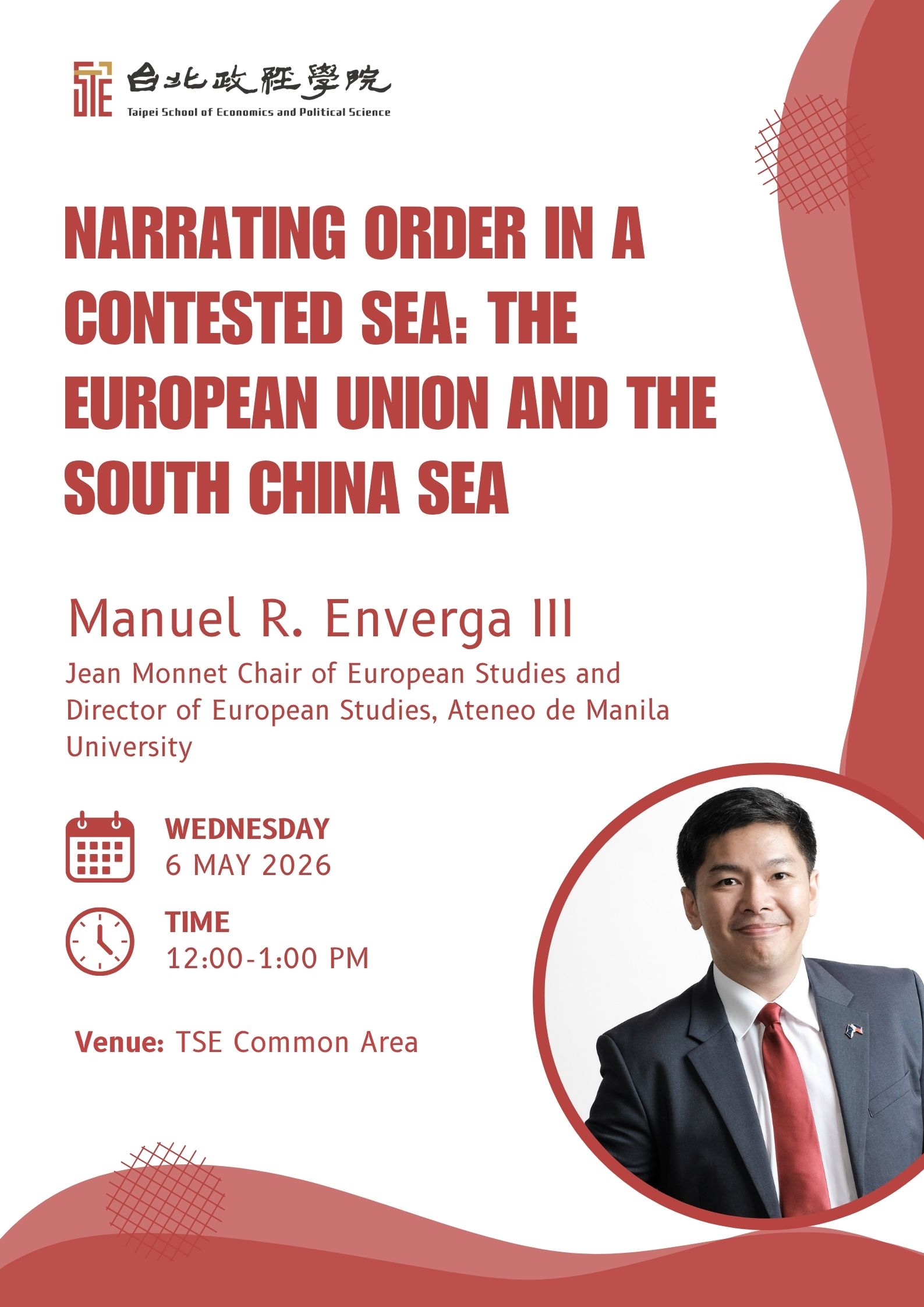
Title: "Narrating Order in a Contested Sea: The European Union and the South China Sea"
Time: May 6 (Wed), 12:00-13:00
Venue: TSE Common Area
Speaker: Manuel R Enverga III (Jean Monnet Chair of European Studies and Director of Ateneo de Manila University's European Studies Program)
Lecture Abstract:
This lecture examines how the European Union (EU) engages with geopolitical tensions in the South China Sea despite its limited military presence in the region. Focusing on the Sino-Philippine territorial dispute as a critical case, it draws on Strategic Narrative Theory and Critical Discourse Analysis to analyze how the EU constructs its role through official discourse. The findings show that the EU consistently frames the dispute in terms of international law, the rules-based international order, and the importance of restraint and multilateralism. The lecture also incorporates insights from research on European digital diplomacy, demonstrating that while the EU articulates a coherent narrative at the institutional level, the practices of individual European states are more fragmented and shaped by differing strategic and economic considerations. Taken together, these findings highlight a tension between unity in narrative and variation in practice. By situating these dynamics within the broader Indo-Pacific context, the lecture explores how actors operating under conditions of constraint use discourse, signaling, and partnerships to maintain influence. It concludes by reflecting on the implications of these findings for regional actors, including Taiwan, particularly in navigating relations with major powers and engaging external partners such as the EU.
Speaker Bio:
Dr. Manuel R. Enverga III is Jean Monnet Chair of European Studies at the Ateneo de Manila University, where he also serves as Director of the European Studies Program. He is also the current President of the European Studies Association of the Philippines. His teaching and research has focused on a diverse set of topics, which include European politics, digital culture, EU-Philippine relations, and digital diplomacy. Outside of his academic work, he has a regular column on The Philippine Business and News outlet called “Continental Drifts”, and hosts The Eurospeak Podcast, where he and his guests talk about European influences on contemporary popular culture.
Lecture Summary (by Samukelisiwe Nothando Dlamini, 2nd year MA):
This lecture explored why European countries and institutions remain involved in the South China Sea dispute despite being geographically distant from the region. It opened with an interesting puzzle: European embassies in the Philippines continue to commemorate the 2016 arbitral ruling by the Permanent Court of Arbitration each year, even though Europe is not directly involved in the territorial conflict and cannot militarily intervene in it. This raises questions about Europe’s motivations and broader role in global governance.
Professor Enverga emphasized that European engagement in the South China Sea takes place on two levels. First, at the collective level where the European Union attempts to present a unified position on a rules based international order and multilateralism. Second, at the national level where individual European member states engage with the issues in different ways depending on their own priorities or the approaches of specific ambassadors. Solving the puzzle requires understanding both the collective EU position and the actions of individual member states.
The talk also provided background on the dispute itself, including the tension between the principles of the United Nations Convention on the Law of the Sea (UNCLOS) and China’s “Nine dash line” claim. The Philippine case is significant because it serves as a test for whether regional conflict will be shaped by international law or power based politics. The 2016 arbitral ruling rejected the Nine-dash line and affirmed the importance of international order. In this case, Europe’s commemoration of the ruling can be seen as support for law over force.
The EU’s role as a global actor was another important point discussed during the lecture. Unlike traditional military powers, the EU relies on diplomacy, economic influence and support for international law to shape outcomes. However, it was also noted that the EU faces constraints because member states maintain control over their own security and defence which makes unified action difficult. Hungary, for example, has opposed certain joint EU statements in the past. This shows how national politics can limit collective positions.
The lecture introduced the concepts of "digital diplomacy" and "strategic narratives". "Digital diplomacy" refers to the use of online platforms and social media to pursue foreign policy goals and reach international audiences. Facebook is recognized as an especially important platform in the case of the Philippines given its popularity. "Strategic narratives" on the other hand are the stories that states and institutions tell about the global system, their own identity and what they believe should be done politically.
Finally, Professor Enverga presented a “discourse-context dialectic” framework which argues that discourse is shaped by its surrounding context while also influencing existing social realities. Through official statements and social media posts, for example, the EU and its member states attempt to promote international law and a rules-based order in the Indo-Pacific region.
Overall, the lecture demonstrated that Europe’s involvement in the South China Sea is less about territorial interests and more about supporting international law, practicing using narratives and digital tools to influence global governance debates. It also highlights the challenges of maintaining unity within the EU while addressing complex international disputes.